
Where things start to break
Deltek is your ERP, and it does what it is supposed to do. It captures transactions, enforces structure, and maintains governance across your financial and project data.
But ERP and FP&A are solving fundamentally different problems.
An ERP is designed to control and store historical data with precision. FP&A requires flexibility, speed, and the ability to model future scenarios across multiple dimensions.
That gap is where teams begin to feel friction when they try to keep everything inside the ERP.
The reason this happens is structural.
ERPs are built on relational databases, which are ideal for governance and storing transactional data. But that same architecture is not designed for fast, flexible analysis. FP&A requires a different type of model, one that can handle multiple dimensions and support rapid iteration across scenarios.
As a result, the ERP cannot effectively serve as both your system of record and your dynamic planning environment.
Although ERP providers, including Deltek, have introduced budgeting and planning modules, the underlying structure remains the same. In practice, these tools often feel rigid and do not support the level of flexibility teams need, which is why the work still ends up in Excel.
Data gets exported, models are rebuilt, and over time you end up with dozens, sometimes hundreds, of versions of the truth.
Over time, the impact becomes clear.
Reporting slows down, confidence in the numbers drops, and even simple questions take longer than they should. Reforecasting or rebaselining becomes a manual effort, especially as government priorities and contract dynamics shift.
There is also a growing security concern, particularly in GovCon environments. Sensitive financial and program data is now distributed across spreadsheets that can be copied, shared, and stored outside of controlled systems.
And as AI becomes more relevant, most teams realize they are not in a position to take advantage of it with their current setup.
What leading teams are doing differently
The shift we are seeing is not about replacing Deltek. It is about unlocking the data that already exists within it.
Instead of trying to force more out of the ERP, leading organizations are creating a layer around it that makes the data usable for reporting, planning, and analysis.
This is where RVNA typically comes in.
Starting point: unlock the data quickly
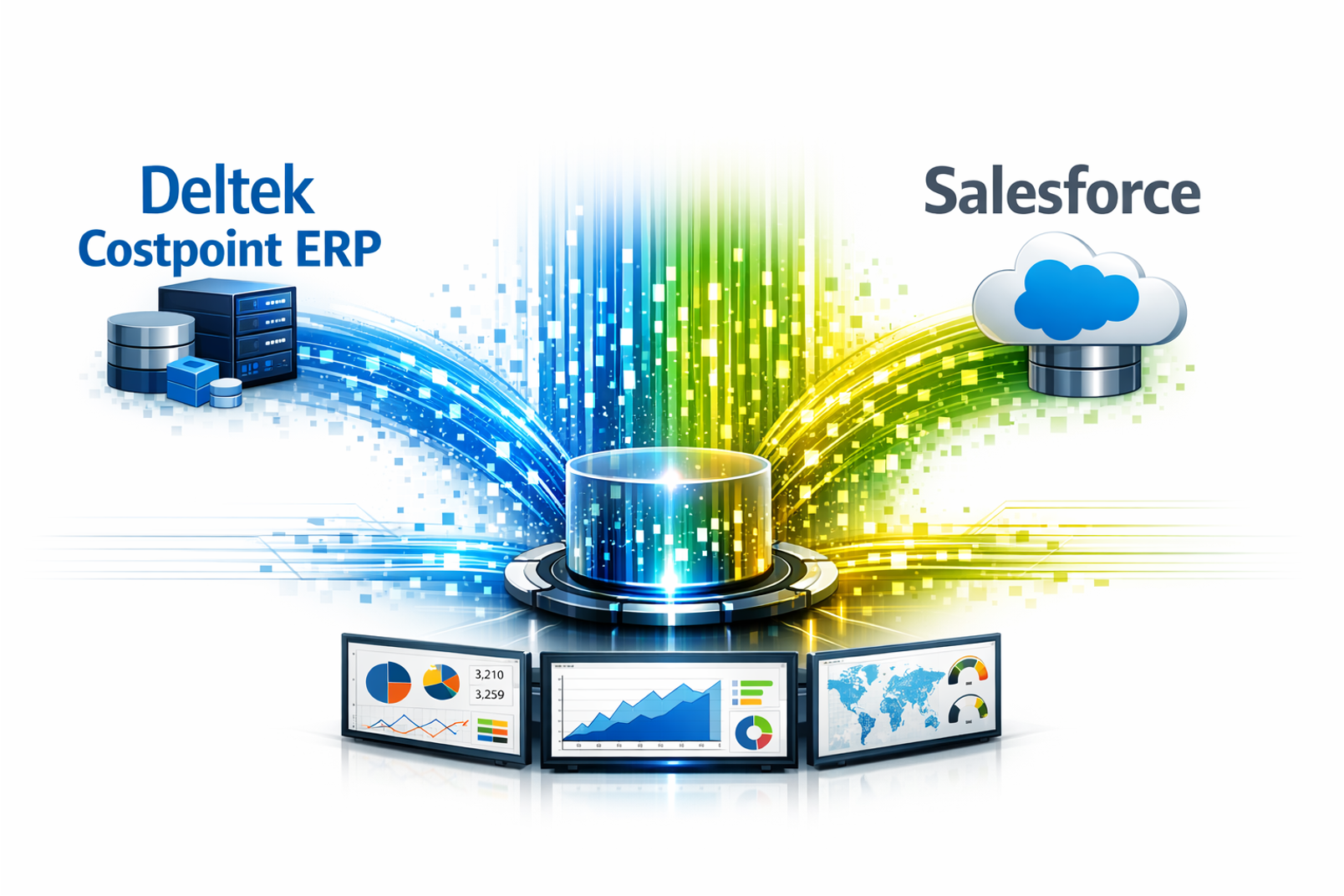
We help our customers extend their Deltek data into a dedicated reporting hub built on a modern cloud stack, designed for dynamic reporting, analysis, and AI.
RVNA has developed a pre-built connector for Costpoint and Vantagepoint that already understands the underlying data structures, mappings, and relationships.
This is where a lot of projects typically struggle.
Getting data out of Deltek is not just about access. It requires building and maintaining scripts, mapping hundreds of fields, and designing transformation logic that works across financials, projects, and labor data. That effort can quickly turn into a heavy consulting exercise, with added cost, delays, and in some cases, failed integrations.
Our connector removes that risk.
It has been used and refined across multiple client environments over the years, with proven logic, pre-built mappings, and transformation models already in place.
Instead of starting from scratch, everything needed to extract and structure your data for reporting is already built.
As a result, we can extract, organize, and load your data into a centralized reporting layer in a matter of days, not months.
Your data is now structured, centralized, and accessible in a secure cloud environment, typically within the Microsoft stack.
Immediate value: reporting that works
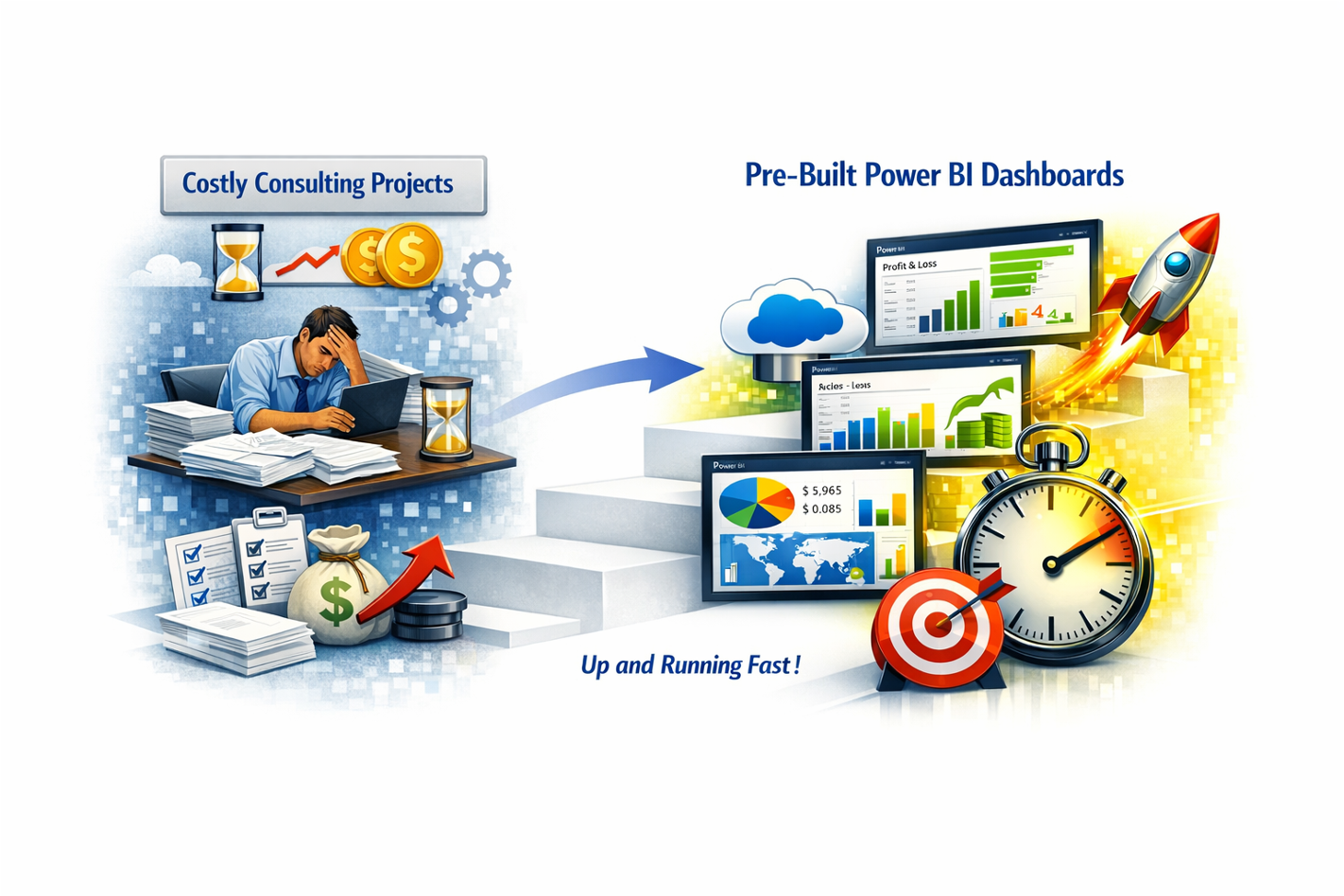
Once the data is in place, we can immediately layer in pre-built Power BI dashboards designed specifically for government contractors.
These include common use cases such as program status reporting, waterfall views, and financial performance tracking. Because these dashboards are already aligned to Deltek data and GovCon requirements, there is no need to start from scratch.
Within days, your team has access to reporting that is faster, more intuitive, and significantly more actionable than what they are used to.
Instead of navigating multiple Deltek screens or managing spreadsheets, users can interact with a modern interface, drill from summary down to transaction detail, and get answers in seconds.
But this is not limited to structured dashboards.
This layer also gives your teams a more flexible environment for ad hoc reporting and analysis. Whether it is finance, program teams, or accounting looking for a specific transaction or detail, many users find it faster and easier to access and explore their data through the Power BI layer than navigating the ERP itself.
We are not replacing Deltek. We are extending its value.
Deltek remains your system of record. The reporting layer becomes the system your teams prefer to use to interact with that data.
From reporting to a data foundation
At this point, the conversation starts to shift.
With a centralized data layer in place, you are no longer limited to Deltek alone. You can bring in CRM data such as pipeline, integrate operational systems, and create a unified view of actuals, backlog, and future work.
This becomes the foundation for more advanced reporting, better decision-making, and ultimately, planning.
What this enables next
From here, organizations can move at their own pace.
Some teams begin extending their reporting with additional metrics and custom views. Others start introducing forecasting, scenario modeling, and AI-driven insights using tools like Copilot on top of their data.
For organizations with more advanced requirements, this same data foundation can integrate directly with CPM platforms like Vena or OneStream, supporting more complex financial planning, consolidation, and close processes.
The takeaway
Most organizations assume this requires a large, complex transformation.
In reality, the biggest shift happens at the beginning.
Once your data is out of Deltek and structured properly, everything else becomes faster, more flexible, and easier to scale.
While we have certainly delivered large transformation projects upfront, often spanning 6 to 18 months, what we are seeing now is a shift in how organizations approach this journey.
More teams are starting with a focused first step, establishing a modern data layer and getting immediate time to value, then building from there.
That is where RVNA focuses, helping government contractors move from rigid ERP reporting to a modern, connected, and AI-ready data environment, one step at a time.